Showing posts with label news. Show all posts

Thursday, March 21, 2013

StarCraft 2: Heart of the Swarm review


StarCraft 2: Heart of the Swarm was designed to be a competitive sport, so it’s only fair that it nicks some of sport’s idioms. The most important of these is cribbed from football: it’s a game of two halves.
The front half: a 20-odd mission campaign with a steadily evolving spread of controllable units spurred on by an earnest, overwrought story of revenge. Dig through that, learn the game’s many long and greasy ropes, and you’ll find the back half: a competitive strategy game so finely balanced and so tactically varied that people are able to play it as their job.

“Watching your host chew Terrans into scrap metal and ripped flesh is consistently enjoyable.”

No matter your experience with Heart of the Swarm’s predecessor, Wings of Liberty – first of Blizzard’s planned three StarCraft 2s – it’s the campaign you should start with. Not simply because it does an appreciable job of teaching new players the basic mechanics for one of the game’s three races – the Zerg, the swarmy stars of this StarCraft show – but also because it’s incredibly well put together in its own right.
Heart of the Swarm delivers on its titular promise early on, quickly gifting players with control of masses of units. The Zerg are numberless in the game’s fiction, and this justifies control of a screen-filling carpet of Zerglings a few missions into the campaign. Wolf-sized Zerglings, like many of the Zerg’s units, are cheap, quick to produce, and disposable in application. But in giving me control of such a vast number of them, Heart of the Swarm not only cemented the differences between it and predecessor WoL, it made me feel powerful. Pointing a host of clawed monsters at a Terran target and watching them chew it into scrap metal and ripped flesh is consistently enjoyable – especially with a physics engine that now ensures torsos and limbs go flying into the distance with appreciable force.
At the heart of said swarm sits Kerrigan. She’s the game’s cover star, and comes in two flavours in both HotS and the series fiction. She started life as a Terran ghost: a human super-sniper with brain-melting psionic powers. After some advanced Zerg gribblification, she grew a natty pair of bony wings and had her entire body turn sparkly purple, taking on the moniker ‘Queen of Blades’. It’s no spoiler to mention she flits between these forms in Heart of the Swarm – the game plasters her Zergified face all over the loading screen – but no matter her appearance, she retains a set of enemy-shredding abilities that get more powerful as the story progresses on.

“When it tries to be po-faced, it’s quite silly; when it tries to be silly, it’s very silly.”

That story is silly in varying ways, with varying degrees of success. Kerrigan begins proceedings trapped in a Terran lab. Semi-friendly to her captors – Valerian Mengsk, son of Terran despot Arcturus Mengsk, and other friends of her beau Jim Raynor – she’s no longer in her guise as the Queen of Blades, de-Zergification having rendered her more human in appearance. A breakout is followed by daddy Mengsk’s intervention, and Kerrigan is propelled back toward her Zerg swarm, and re-de-re-Zergification.
Her story is one of blind, stabby revenge, a tale of crossing the galaxy and interacting with its most powerful beings with the express intentions of offing one beardy dude for being really, really annoying. When it tries to be po-faced, it’s quite silly; when it tries to be silly, it’s very silly, a pulp sci-fi story dictated by the surprise success of characters and plot coined in the late 1990s. It feels like a resurrection of that era of nuance-less science fiction – a time when space marines could be space marines, horrible chitinous monsters could be horrible chitinous monsters, and the two could fight without origin stories or complex motivations – but Blizzard are happy to embrace StarCraft’s origins, not attempt a reboot.
In embracing it, they justify Kerrigan’s semi-mystic power, and subsequently her in-game powers. These increase in impressiveness as she levels up: an early ability enables her to lift a handful of enemies into the air, their little arms waving as Kerrigan’s army nibbles at their legs; a mid tier skill lets her conjure six acid-filled Banelings out of the ground, ready to hurl at nearby opponents. Her final few abilities are ridiculously powerful: one allows her to call in her vast Leviathan ship. The beast hovers malevolently around the map, prodding things to death with sandworm-sized tentacles.
The Leviathan skill can be replaced by a portable nuke, or by a set of drop pods Kerrigan can call in to spawn an entire army at a moment’s notice. Her skills sit on a tech tree, and demand that players choose between two (later three) abilities at certain levels. Kerrigan acts like an action-RTS hero on the battlefield, and players have the ability to outfit her for a range of functions. She can be given a set of healing and buffing auras and told to stand next to the bulk of your army, or you can build her – as I did – for pure damage output, speeding deep into enemy ranks, chucking blasts of kinetic energy, and darting back out with a city-sized spaceship in her wake.

“Your newest organic toy is always ideal for the mission ahead – but victory is never assured.”

That’s not the only action-RTS influence in Heart of Swarm’s campaign. A number of missions feature the endless streams of dumb AI units that characterise that genre (originally born from Blizzard’s games: the circle is complete). One mid-campaign level is fringed by a constant battle between two rival Zerg factions. Their two streams meet at the bottom of the map, extra forces sometimes spilling off to attack Kerrigan and her own brand of Zerg at the top of the area. The persistent creep conflict is technically superfluous to completing the mission – Kerrigan need only survive for 25 minutes – but a bonus objective requires crossing the stream, necessitating a serious battle plan on higher difficulties.
All of Heart of the Swarm’s campaign missions are this thoughtful. The story introduces new units at a deliberate pace, inevitably making your new organic toy ideal for the mission ahead – but victory is never assured by simply building lots of new unit X. Each mission has a gimmick to go alongside its new Zerg arrival: an early stage on the ice world of Kaldir introduces flash freezes that root the local Protoss to the spot for a minute at a time, allowing systematic destruction of their bases. A later mission asks Kerrigan to harvest meat from indigenous creatures on a jungle planet: a task that required me to build up my base, push out onto the map with a sizeable force, kill the critters, send a worker Drone to collect the meat, and protect it on its journey home, all while stopping my opponent’s forces from destroying my meaty treats or attacking my base directly.
There’s no one way to win in singleplayer. Chris – playing the game through on hard – had trouble with a level that introduced Swarm Hosts to Kerrigan’s arsenal. He ended up eschewing the pustule-covered siege units entirely and built up a combined force of Roaches and Banelings to win the day. I took a different path and spawned a flock of Mutalisks to do the same job in another way.

“The Zerg army Kerrigan controls is made powerful by multi-tasking and distributed thinking.”

This choice is hardcoded into the game. As well as Kerrigan’s personal tech tree, I was able to choose one of three specialisations for each of my units – increased health, damage, or speed, for example – decisions I could alter between missions. Heart of the Swarm also offers irreversible decisions: each controllable unit earns an evolution mission that displays two options for improvement – players have to pick one. I gave my Zerglings wings, letting them jump up cliffs, made my Roaches spit debilitating acid, and tweaked my Ultralisks so on death, they crawled inside a cocoon and came back to life a few seconds later.
Later levels give Kerrigan full control of the swarm’s Zerg strains and multiple bases from which to produce them. On normal difficulty, these felt more like showcases than strategy – too hard to lose against a lacklustre enemy showing, and more an opportunity to breed a few of my favourite units and give them names. There’s less time to introduce people to Charles von Broodlordingtons on hard and brutal difficulties. These demand serious skill and RTS mechanics, particularly when the Zerg army Kerrigan controls is made powerful by multi-tasking and distributed thinking. If you can hack these, you’ll do well on Heart of the Swarm’s multiplayer ladder
That multiplayer forms Heart of the Swarm’s second half. It shares units with the campaign, but there are hefty differences: it’s played at ‘faster’ speed compared to the campaign’s ‘normal’, and it assumes a familiarity with keyboard shortcuts, expansion timings, map knowledge and unit counters that the singleplayer rarely does.

“HotS doesn’t remove any units from Wings of Liberty’s online mode, resolving to tweak rather than cull.”

It’s almost exactly the same as Wings of Liberty’s multiplayer. Heart of the Swarm doesn’t remove any units from that game’s much-loved hyper-competitive online mode, resolving – after threatening to ground the Protoss Carrier spaceship – to tweak rather than cull. Some examples: Terran Reapers still jump up cliffs and carry infantry-shredding pistols, but they no longer require a tech lab attachment on a barracks, and now regenerate a small amount health over time. Medivacs still heal nearby biological units, but now come with turbo-charged boosters that grant them a few seconds of faster flying time.
The Medivac speed upgrade allows Terran players to multi-task with abandon, dropping squads of infantry units in vital places across the map. Before, they would’ve lost said squad had the enemy reacted fast enough; now, they can simply pack them up and boost off into the sunset. The Terran versus Zerg matchup was once dominated by Siege Tanks – now players, from professional down to the online ladder’s bronze league denizens – are using Medivac drops against Zerg opponents.
A few tweaks were more substantial. The Protoss Mothership was little used by the race’s players, crowd’s often cheering if one was constructed in a professional game. Now it’s available earlier, for cheaper, as the Mothership Core. It comes with the same range of abilities, but a drastically reduced health pool, making its application complicated, but rewarding: mass recall allows careful Protoss to surgically strike their opponent’s base before flitting back home in an instant to avoid danger.
Tweaked units are joined by downright new ones. Strangely, for a Zerg-focused expansion, it’s the Protoss who’ve earned the most interesting addition: the Oracle is a fragile floating green bulb that can destroy worker units in a few blasts from its lasers. It also comes packaged with a set of spells that careful Oracle drivers can use to aid their army, or provide vision of an enemy base. The professionals are yet to figure out its correct usage, but it’s Heart of the Swarm’s most interesting new multiplayer unit.

“Tweaks and additions change the complicated metagame in wonderful ways.”

Pros have had less trouble figuring out the new Terran Widow Mine. Mines can burrow – in this position they hop out of the ground and latch themselves onto anything that steps within their radius, blowing up and beginning a 40-second cooldown before they can re-explode. Widow Mines were the breakout stars of the most recent Major League Gaming championships, Terran players finding hidden, automatic bombs easier to use than the Protoss’s complicated Oracle.
These new units are rounded out by one or two additions per race: the Zerg Viper and Swarm Host, the Protoss Tempest, and the Terran Hellbat. To the untrained eye, these are small, piffly changes that feel like a poor haul given three years of development time. Those untrained eye owners will see the same StarCraft 2 as before, a thimble-full of new units changing very little: the actual mechanics of competitive, base-building, classic RTS are unchanged.
But even to my semi-trained eye – I’ve logged more than 500 hours of Wings of Liberty 1v1 multiplayer – these tweaks and additions change the complicated metagame that’s built up around StarCraft 2 in wonderful ways. The Oracle promotes Protoss harassment and multi-tasking, a first for the race that’s relied on sitting back and building up multi-unit ‘deathballs’ before rolling over the map like a golden fist. The Zerg Viper and Swarm Host finally give the swarm the options to deal with Terran Siege Tank lines, the latter distracting the Tank’s guns while the former yanks it out of position with its abduct skill. And the Terrans have already altered fundamentally at the hands of highly skilled players: once the turtler’s favoured race, they’re now characterised by multi-pronged assaults and fine control.
Heart of the Swarm’s success comes in opening Wings of Liberty’s superlative multiplayer up, making a variety of strategies viable again, rather than perpetuating the one right way to play a match-up. It also retains that game’s fantastic matchmaking system: Wings of Liberty sunk its talons into me on launch when I played my first online game and eked out a win, the game matching me against a player of similarly limited skill. It’s StarCraft 2′s ability to provide a consistently close, tense match that makes it such a thrilling multiplayer game, and Heart of the Swarm chooses opponents that suit my skill level: after fifty multiplayer games, I’ve won about half of my games – the ideal percentage.

“It’s SC2′s ability to provide a close, tense match that makes it such a thrilling game.”

But none of Heart of the Swarm’s multiplayer additions and tweaks will mean a thing if you’re not invested in the process of playing online and increasing your ladder ranking. Those people have a fifteen hour glossy, deep, and – on harder difficulties – strategic campaign to busy themselves with. Those Wings of Liberty veterans for whom the campaign is a distraction from the process of league ranking promotion will find an essential multiplayer mode made all the better for its new faces.
Those who bounced off both of StarCraft 2′s halves with Wings of Liberty’s launch won’t find anything to draw them in here. Beyond balance changes and nods to MOBA design, Blizzard are playing the same classic RTS game as they were in the late 1990s, one that can feel anachronistic and dated against more forward-thinking strategy peers. But both parts of Heart of the Swarm’s RTS whole – multiplayer esport and solo campaign – are so finely balanced and so cleverly produced that, to borrow another sports idiom, Blizzard have moved the goalposts.


Tuesday, March 19, 2013

Gears of War: Judgment Review


Have a seat, Marcus and Dom. Time for some other hulking soldiers to lead the fight against the Locusts.
The two stars of the Xbox 360's stellar shooter franchise Gears of War step aside for comrades Baird and Cole in the prequel Gears of War: Judgment, a faster-paced action game that features all the chainsaw-filled goodness and intensity players have expected from the series.
Taking place before the start of the Gears of War trilogy, Judgment follows Kilo Squad and its leaders, the wise-cracking Damon Baird and Augustus Cole (known to many players as "Cole Train"). They're joined by cadet Sofia Hendricks and Garron Paduk as they try to save the city of Halvo Bay from a Locust onslaught.
The campaign starts with Kilo Squad on trial, recounting the events of Halvo Bay before a colonel with the Coalition of Ordered Governments (COG). The events of the campaign that players participate in are based on testimony from squad members.
Scattered throughout the campaign are "crimson omens" on walls representing optional, declassified sections of a mission. The declassified portions add a layer of difficulty to combat segments within a campaign chapter. For example, some sections may require players to use only shotguns or limit their ammunition, while others add more challenging Locust enemies such as Corpsers or Reavers. Perhaps the most challenging are moments where vision is impaired by darkness or heavy dust clouds.
Players earn up to three stars for each stage, and "declassifying" a mission will speed up the process. These stars go toward unlocking items for Judgment's multiplayer and cooperative components. Players can also win prizeboxes that unlock additional experience points and weapon skins.
Judgment handles like the traditional Gears of War title. The A button is your best friend for evading enemies, performing "roadie runs" to escape danger and to find cover. Players use the right bumper to reload, jamming their weapon or reloading more quickly depending on timing. Of course, there's also the wonderful weapon selection from Lancers with chainsaw bayonets, Boomshots, Longshots and Gnasher Shotguns. Fresh items are tossed into the mix, including a Breechshot, a sniper rifle without a scope, and a grenade launcher called the Booshka.
The pace is a bit quicker compared to the Gears of War trilogy. Developers at Epic Games ditched the directional pad, making access to weapons and grenades easier. Players now simply toss their grenades while carrying a firearm. Also, they can quickly switch between a pair of weapons with the Y button.
The boost in speed is necessary, considering Judgment tosses every powerful Locust enemy at players from the very start, from smaller wretches to the all-new Rager that grows stronger and tougher after players shoot them. The campaign also takes inspiration from Gears of War's popular Horde mode, as some sections require players to survive waves of Locust to advance. It's pure chaos, but in an exciting way.
Once the Judgment campaign is complete, players unlock a second, shorter Aftermath campaign that takes place alongside events in 2011's Gears of War 3. Baird and Cole are still the stars, as they revisit Halvo Bay.
There's also a handful of online cooperative and competitive modes. The popular Team Deathmatch returns, as does Execution, where two teams of five fight to kill each other within a set time limit. Judgment adds a Domination mode, which fans of first-person shooters such as Call of Duty or Battlefield will recognize. Players must capture targets on a map and hold them to earn points.
The star of multiplayer is Overrun, which pits a Locust team against COG soldiers protecting a generator. COG members choose one of four classes: Scout, Engineer, Soldier or Medic. Each boasts a special ability such as building turrets or handing out ammunition. Players operating as Locusts start out small, fighting as Drones, Tickers or Wretches before earning points and upgrading to more powerful foes such as Serapedes or the Kantus. It requires more strategy and teamwork compared to other Gears of War modes, making it far more enjoyable.
On the strictly cooperative front, Horde mode is replaced by Survival, which is similar to Overrun, only players operate as COG soldiers fighting off waves of Locusts trying to destroy a generator. It's a decent option, but not as satisfying as the epic matches players can put together in the traditional Horde mode.
Fans of the trilogy should find Gears of War: Judgment an exhilarating expansion and another worthwhile reason to rev up the chainsaws.
Publisher: Microsoft
Developer: Epic Games/People Can Fly
Platform(s): Xbox 360
Price: $59.99
Rating: M for Mature
Release Date: March 19

The Elder Scrolls Online Just Might Be Awesome!


Just to get it off my chest, let me count the ways in which Elder Scrolls Online isn't like Skyrim, Oblivion, or Morrowind – the series’ most recent (and famous) entries. Merchants don't have limited supplies of money, and you don't trudge along as though you're carrying the world once your bags are filled. You can't attack friendly NPCs, and the folks you can kill don't drop the exact items they were wearing. Elder Scrolls Online lets you rummage through most crates and collect items such as skill books, but you can't physically pick them up and drop them at your leisure. Role-play lovers, despair: you can't sit in chairs. Most heartbreaking of all, you can't revisit low level zones and still find a challenge even at the highest levels. That's already a pretty hefty grab bag of caveats that may turn off a chunk of the Elder Scrolls fanbase, but it's a testament to the quality of the work that ZeniMax Online has done here that I felt as though I was playing a genuine Elder Scrolls release nevertheless.
They certainly get the ambiance right, beginning with my arrival on the parched island of Stros M'Kai via a ship in the vein of Morrowind, as well as in the countless NPCs I encountered with fully voiced choice-based dialogue options. Moments of beauty were many, particularly when I made my way to the leafy orcish island of Betnikh around level 5. The serene interface recalls the immersive simplicity of Oblivion's display of health, magicka, and stamina, although number-conscious MMO veterans can activate a more cluttered interface by clicking the Alt button. What little I saw of crafting – cooking, specifically – involved a system of experimentation similar to that found in Skyrim. The questing, too, went far beyond throwaway text to justify killing the pirates of Dwemer I encountered; at times it affected the development of my own story progression. In one, for instance, I helped rescue a thief named Jakarn from prison and then recapture his stolen gem, only to find a grumpy orc named Moglurkal waiting outside the dungeon for us and demanding the return of the jewel. In contrast to other MMORPGs, I had the option to lie about having the jewel, and I took it. Had I not, I wouldn't have seen Jakarn popping in to help me and give me new quests on Betnikh.
My four or so hours of hands-on gameplay in ESO brimmed with moments like these, and the choices felt much more meaningful than the simple light/dark options of Star Wars: The Old Republic. Even better, you don't have to worry about your punky leveling buddy forcing story decisions on you that you don't want to make. I saw this most prominently when a colleague I was grouped with made different decisions as to how to handle a poisoned ship captain; I gave her an antidote and let her live, she let her die. But even though we were grouped and in the same room, I saw events unfold differently, and later, the captain came to my aid when I needed her help. I'm looking forward to seeing how it unfolds throughout the whole game, as I found that ESO offered a rewarding single player storyline that never comes close to ditching social elements so vital to MMOs. In fact, with open mob tagging, shared servers, and spell combos that require two or more players, it promotes it.
Sword Play
The combat feels very much like what you'd find in an Elder Scrolls game; the bad news (particularly for melee-oriented players) there is that means it's subject to the series' signature stiff animations. But here's the thing – I felt as though I was actually hitting stuff. Playing with a sword and shield, I reveled in the familiarity of using my left mouse button to both block and bash for spell interrupts, and immediately found myself holding down the right mouse button for power attacks and merely clicking it for lighter ones. It's fun, but I was dismayed to learn that I couldn't play Elder Scrolls Online as I usually play Skyrim – specifically, as a stealthy archer who whips out either daggers or swords in close quarters. I could use the bow (although the arrow's trajectory looked more like I was tossing it than firing it), I could sneak by pressing Control (although stealth bonuses, I'm told, won't unlock until I've leveled medium armor a ways), but I still found myself frustrated when I couldn't whip out my sword when my quarry finally reached me. For that, I was told, I'd have to wait until level 15 when weapon swapping unlocks.
The concept could work well, particularly since a new action bar pops up every time you equip a new weapon, and Elder Scrolls Online's take on this mechanic offers a far greater range of customization than what you find in Guild Wars 2's similar interface. Indeed, there's another reason why I'm looking forward to trying it out in the future. By far the biggest announcement of the day is that Elder Scrolls Online will feature first-person combat after all, and while my experience with it was limited to watching a minute-long video of an early build set in a graveyard, I loved what I saw, particularly for the promise it holds for archery.
Alas, one reason why the first-person perspective sounds enticing is that I never really warmed to the appearance of the Breton I chose out of the three available races from the Daggerfall Covenant (along with orcs and Redguards). His muddy features suggested he'd be far more at home in Oblivion than Skyrim, but I nevertheless appreciated the way I could make the most minute adjustments to everything from his build to how he squints. Elsewhere, the freedom of development was well-suited to my fairly rushed playthrough to level 7. True to Elder Scrolls (particularly before Skyrim), the three available classes of Dragonknight, Sorcerer, and Templar were more like suggestions than set-in-stone templates, and I appreciated the ease with which I was able to transform my Sorcerer into a bow-wielding, medium armor-wearing ranger. If that isn't Elder Scrolls, I don't know what is.
The Right Moves
It's too early to make judgments, but even in its current form, I could see myself logging into ESO regularly to satisfy my personal craving for more Elder Scrolls content. I'm also happy to see that the design so far seems focused on exploration and questing rather than grinds. There are no raids, after all – "That's not Elder Scrolls," says Game Director Matt Firor – but there are four-man dungeons and three-faction open PvP with sieges in the beleaguered province of Cyrodiil. From the live dungeon run I saw, they play with a dynamism akin to what you find in Guild Wars 2 but with a welcome degree of control, springing Elder Scrolls Online's embrace of the so-called trinity of heals, DPS, and tanks. ”Dark Anchors” – a dynamic grouping component – also open from Molag Bal's plane of Oblivion, but in all honesty, they bore such a striking similarity in both concept and appearance to Rift's titular rifts such that I worry they'll get old fast.
For all the risk that an MMO presents for a franchise that’s been rock-steady in its adherence to the MSORPG (massively single-player role-playing game) discipline, I’ll say this about ESO: I wanted to keep playing. I wanted to find out what lay at the end of an unmarked riddle quest I'd found in a half-buried treasure chest, and I wanted to find adventures lay in wait in the alleys of Daggerfall. All this is but a scratch of what I encountered in Elder Scrolls Online over four hours of gameplay, and if ZeniMax can maintain that drive to keep exploring up to and past the level cap of 50, their creation might just be worthy of the Elder Scrolls title after all.

Saturday, March 16, 2013

God of War: Ascension, Good but not Great

Kratos prepares for battle in a scene from 'God of War: Ascension.' / Sony Computer Entertainment

Wait, you thought slaying every Greek god in existence meant an end to the tales of
 God of War hero Kratos?
Not so fast. The muscular and merciless warrior of Sony's epic God of War action franchise returns in prequel God of War: Ascension for the PlayStation 3. Although the "hack-and-slash" title is filled with the same grandeur of the original trilogy, it lacks those titanic moments that helped make the franchise so spectacular.
For those new to God of War, Kratos is a Spartan soldier who vows to serve Ares, the god of war, if he grants him the power to slay his enemies. Kratos' tale turns tragic when he is tricked into killing his wife and daughter, setting him off on a quest to kill Ares.
Ascension takes place six months after his family's murder, as Kratos breaks his pact with Ares and seeks revenge. Instead, Kratos is trapped in a prison dominated by the Furies, a group of female deities attempting to drive Kratos mad.
The prequel features all the trademarks fans ofGod of War have come to expect. Armed with the Blades of Chaos attached to his wrists by chains, Kratos slashes through a variety of enemies such as giant cyclops, three-headed dogs (Cerebus) and a new "elephantaur," a hybrid elephant/minotaur. The combat delivers the same physicality and brutal finishes that have made the series popular.
Magic is handled a bit differently in Ascension, connected more closely to Kratos' blades. Players can link their swords to powers tied to four gods: Ares (fire), Poseidon (ice), Zeus (lightning) and Hades (souls). Each come with their own set of special attacks and specific magic strikes to slow down enemies. For example, tapping the R2 button while equipping Hades' abilities unleashes a flurry of souls, while the Poseidon ability starts an icy tornado freezing enemies. When opponents glow red, players can perform a "brutal kill" for an especially gory finish.
Players will find green and blue chests scattered across the landscape to replenish health and magic. Red chests give players points to upgrade their powers and blades, while white chests carry Gorgon Eyes and Phoenix Feathers to enlarge health and magic meters. Players can also pick up other weapons such as larger swords, hammers or shields for bonus melee strikes.
Ascension beefs up navigation and puzzle elements of the series through an amulet Kratos picks up that can manipulate structures and stop time. When an object glows green, players can use the amulet to rebuild or decay a structure. Some puzzles require players to partially rebuild a bridge or other structure to advance. Plus, players can use it as a quick way to suspend enemies in mid-air and hack away.
For the most part, Ascension is as enjoyable as every other God of War game. The presentation remains impressive, effectively using dramatic camera angles to make the world and his enemies feel massive. It's a game worth of its mythological subject matter. The combat is equally thrilling. Transitioning between attacks and rolls or other moves feels effortless, as players perform a variety of combination attacks to tear through opponents.
However, Ascension seems to carry one tragic flaw. Why should I care about this quest, exactly? The God of War trilogy earned its rise in popularity in part because of the incredible cast of characters Kratos battles. By comparison, Ascension's cast of villains seems rather tame, which results in fewer memorable moments. That's the price it pays for following up a trilogy that had players slaying a Hydra, several Greek gods and a fantastic sequence in God of War 3 where players battle the titan Cronos.
Ascension also introduces multiplayer to the God of War series for the first time. The third-person action genre doesn't dive into the multiplayer pool often, but it works surprisingly well in God of War. Players start with brief training followed by picking an allegiance to either Zeus, Hades, Ares and Poseidon. Each god carries his own advantages. Ares gives players more physical power, while Zeus is more focused on elemental abilities.
After choosing a god to follow, players explore a variety of matches such as Favor of the Gods, where two teams fight to capture altars and gain favor points, and the cooperative Trial of the Gods where players must survive increasingly tougher waves of enemies. Players earn experience toward adding armor, weapons and magic abilities.
It seems Ascension hasn't been blessed by the video game gods, if such entities did exist. It's a really strong title, with the same vicious combat and a clever multiplayer component. It just suffered the unfortunate luck of following up three very powerful console predecessors.
Publisher: Sony Computer Entertainment
Developer: Sony Santa Monica
Platform(s): PlayStation 3
Price: $59.99
Rating: M for Mature
Release Date: March 12

Thursday, March 14, 2013

Tomb Raider 2013 Review:


“There are no heroes here, only survivors” – Matthias, Tomb Raider

Lara-Croft-Tomb-Raider-2013-character
When the first trailer was shown for the new Tomb Raider, I was among the skeptics. It looked like another game with an over-sexualized heroine, and there was even a potential rape scene! However, as I mentioned in a previous article, after watching all of the trailers, I came to a different conclusion: Tomb Raider was probably going to be awesome. Other journalists told me not to get my hopes up.
It feels good to be the one smirking now.
I was right! They did it! They told a woman’s story, the story of her growth into a survivor, in a completely compassionate way. Yes, her body is still a little on the fantastical side (also, why didn’t she ever steal someone’s parka so she could stop shivering?) and yes, she often makes dumb mistakes and gets herself into all sorts of ruckus, but those are minor details and really such an improvement over the norm. One step at a time! And this was a pretty big step.
Tomb-Raider-2013-Screen-11
The game also includes a few homages to past games and movies, which I loved. This new Tomb Raider is completely modern, and yet retains the feel of the classic Tomb Raiders. I felt it the first time I wandered into a water-filled cave. As I moved slowly through the water, a wave of nostalgia hit me. Luckily, no bats or batshitcrazy T-Rexes made an appearance!
So, without further ado, let’s zipline-and-crazy-pickax-jump into this review! This covers the PS3 version ofTomb Raider, which does not include her fancy “every strand of hair moves” technology that the PC version came with.

Package

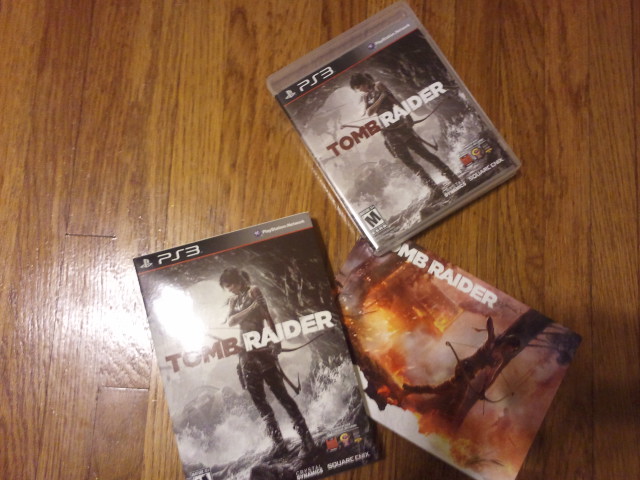
Check out my unboxing video here. The game came with a code for a scavenger hunt (that I was apparently supposed to do before the game came out) a mini art book, and Tomb Raider: Final Hours, which works through the Amazon Appstore.
tombraiderfinalhoursedition

Plot

“Armed with only her instincts and her innate ability to push beyond the limits of human endurance, Lara must fight, explore, and use her intelligence to unravel the dark history of a forgotten island and escape its relentless hold.”
In this reboot of the series, a young, 21-year-old Lara is on her first archaeological adventure, looking for the kingdom of Yamatai. Following a hunch, she convinces the crew to head into the Dragon’s Triangle and its deadly storms.
From there, everything hits the fan in a rolling avalanche of crazy.

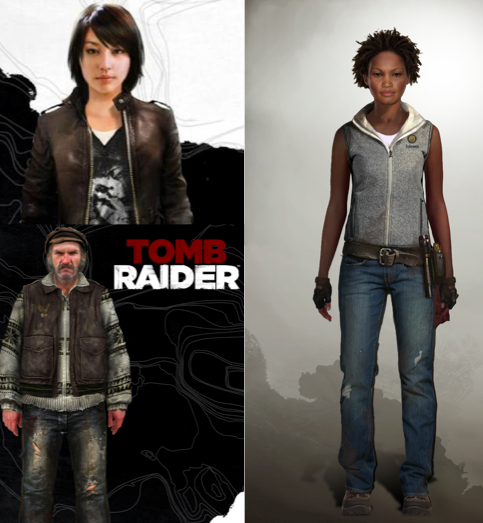
Characters

tombraidercharacters
  • Alex – Know-it-all nerd boy who just wants to impress Lara.
  • Jonah – The spiritual brown man, he’s nice, patient, never loses his temper, and gives me presents. He also has a dark past.
  • Sam – The director of the expedition’s film. I loved seeing a woman in this role, as it’s very rare to see female directors represented in any medium. She also cares deeply about her roots, as well as Lara. She miiight be sweethearts with Lara.
  • Reyes – The tough girl with a heart. She is tough on Lara and has little patience for her. She’s also a mechanic and single mother.
  • Roth – Is the fatherly figure who taught Lara everything she knows.
  • Grim – The badass old man. You get the idea that he, Roth, and Lara’s dad had some crazy adventures of their own.
  • Whitman – The prima donna douchebag and head archaeologist of this expedition.
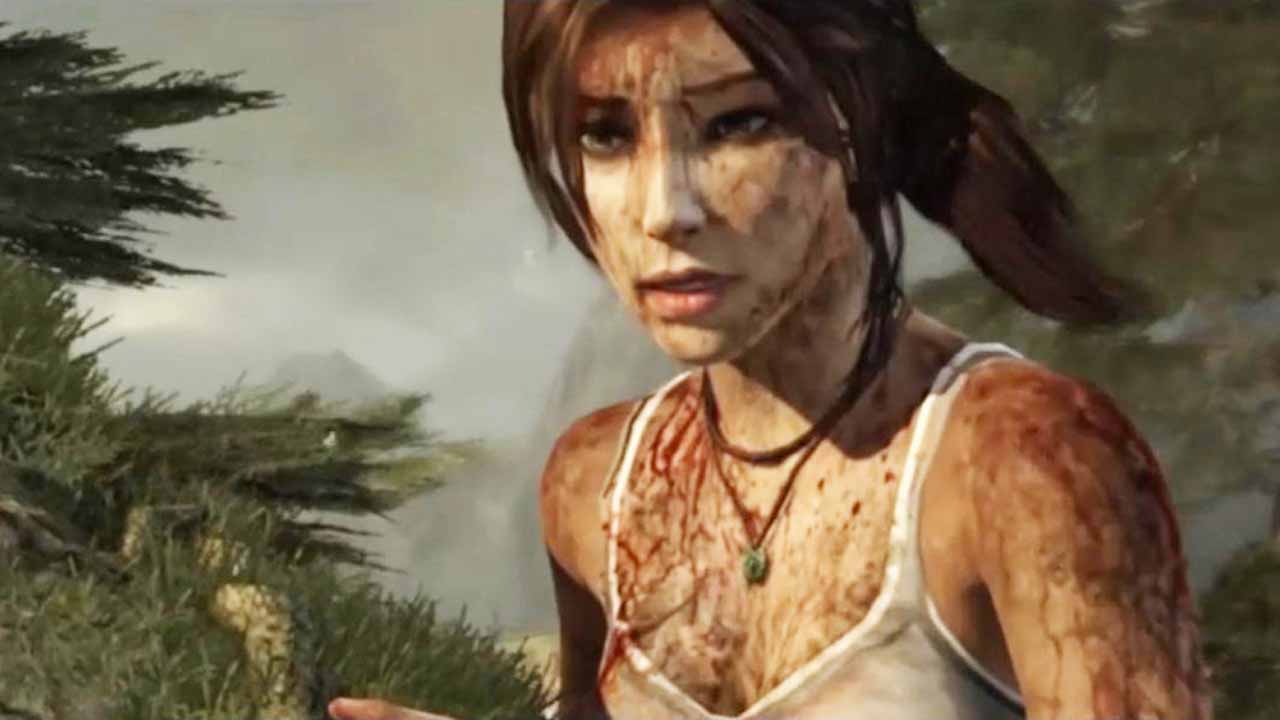
  • Lara Croft – The young and passionate Lara lives on instinct, much as she is told to. Unfortunately, her instincts tend to lead her and others right into danger. Also, she comes off as a little booksmart but street dumb, constantly tripping on vines, loudly calling out for people instead of hiding, and never picking up a parka from one of the many dead, fully-clothed people around her. As for her new look, her arms should be way more muscly, but in general, her body is proportional and more realistic than past representations (though I still think her lower back is probably aching and hey, she keeps using a bow but doesn’t bind her breasts, but whatever, survivor, wooo!).
I love this multicultural cast of characters and I enjoyed learning more about each of them. You find out most of the info through reading documents or, rather, having documents read to you by their voice actors. It often lends a haunting and melancholy air to the adventure.
lara_infiltration_wide-d74e99350fb6573c81c60aae2fbe07a6bd8e5f49-s6-c10
As great as it is to have a diverse cast, I do have to point out that they each turn into tropes by the end of the game. The exciting news is that those tropes aren’t based on their race or gender, but more on roles of other characters in action movies. Yes, Reyes is a single mother and has a bad temper, but she is also a mechanic, a strong leader, and has a sweet side that is shown only when talking about her daughter or around her secret beau. Jonah is the mystical brown man, but he also has a troubled past, and his mysticism has more to do with his personality than his race.
All in all, I was very pleased to see this group, and I hope other games take note!

Graphics and Sound

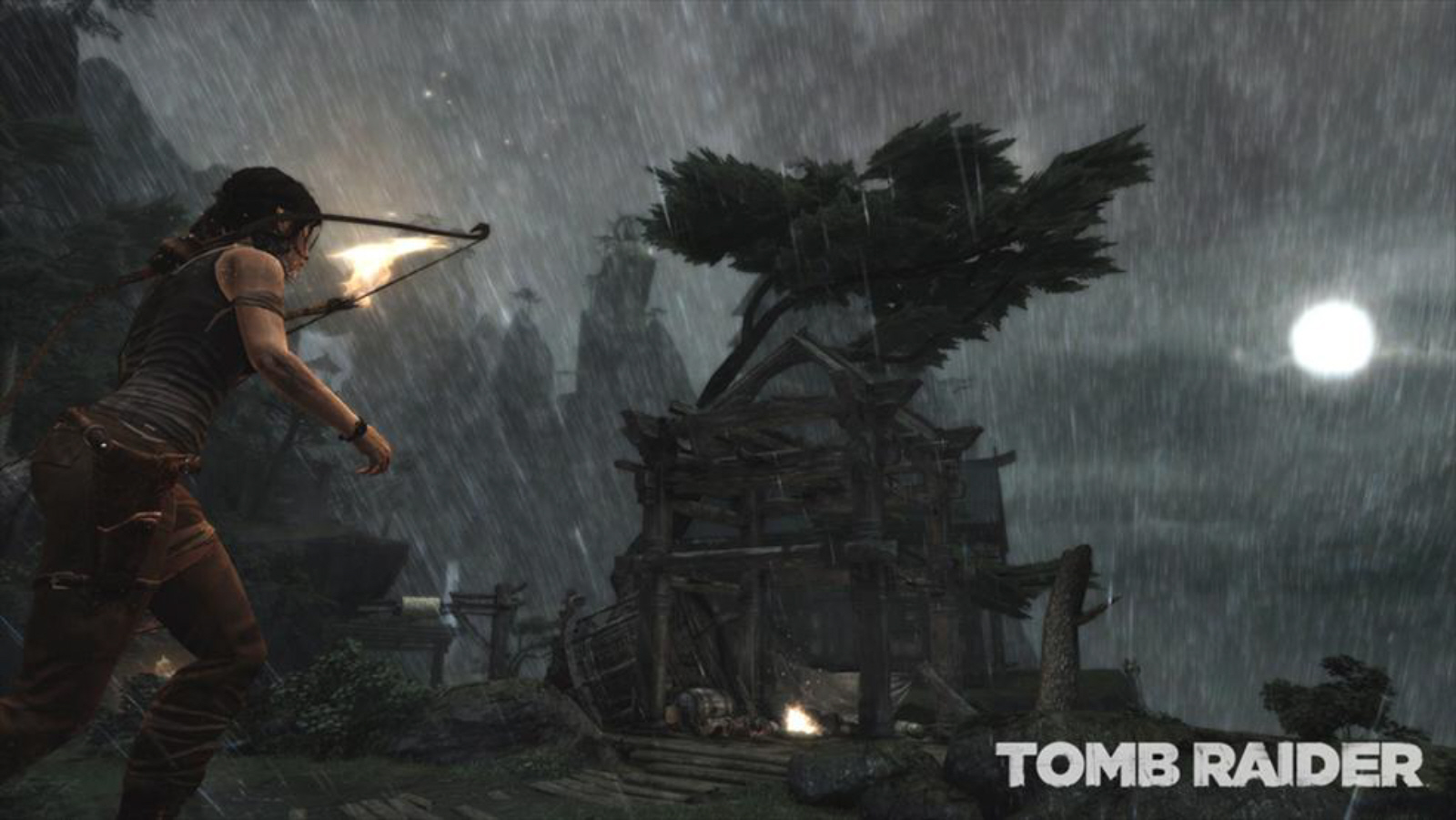
This game is lovely. Environments often equate to eye-porn, with the complementary music adding a sense of loneliness to Lara’s journey. The atmosphere in this game was just spot on. I was creeped out, excited, sad, whatever they wanted me to feel.
tombraidershantytown
The characters look stunningly realistic, and on the PC version Lara has TRESSFX, lending super realism to her…hair.
I played on the PlayStation 3 and saw only one glitch, where a gun was floating in the air, lonely and aloof.

Gameplay

The gameplay of this game is really and truly a blend. It’s not exactly a survival game, because you don’t need to eat to live, and ammo is plentiful. It is an action game with strong puzzle and shooter elements.
In general, the gameplay made me think of Far Cry 3 (PS: holy fast-travel batman!) and Uncharted. Oddly enough, a lot of the controls reminded me of DMC: Devil May Cry, but that’s probably just my brain being strange. Either way, I felt that this was the kind of game that would have been more difficult to play if it had come out a few years prior, but instead feels like a natural evolution of game mechanics.
Quicktime

Quicktime events were used heavily throughout the game. You all know how much I hate quicktime events, but at least these generally did not take away from my ability to see what was happening on the screen.

Tools and Skills

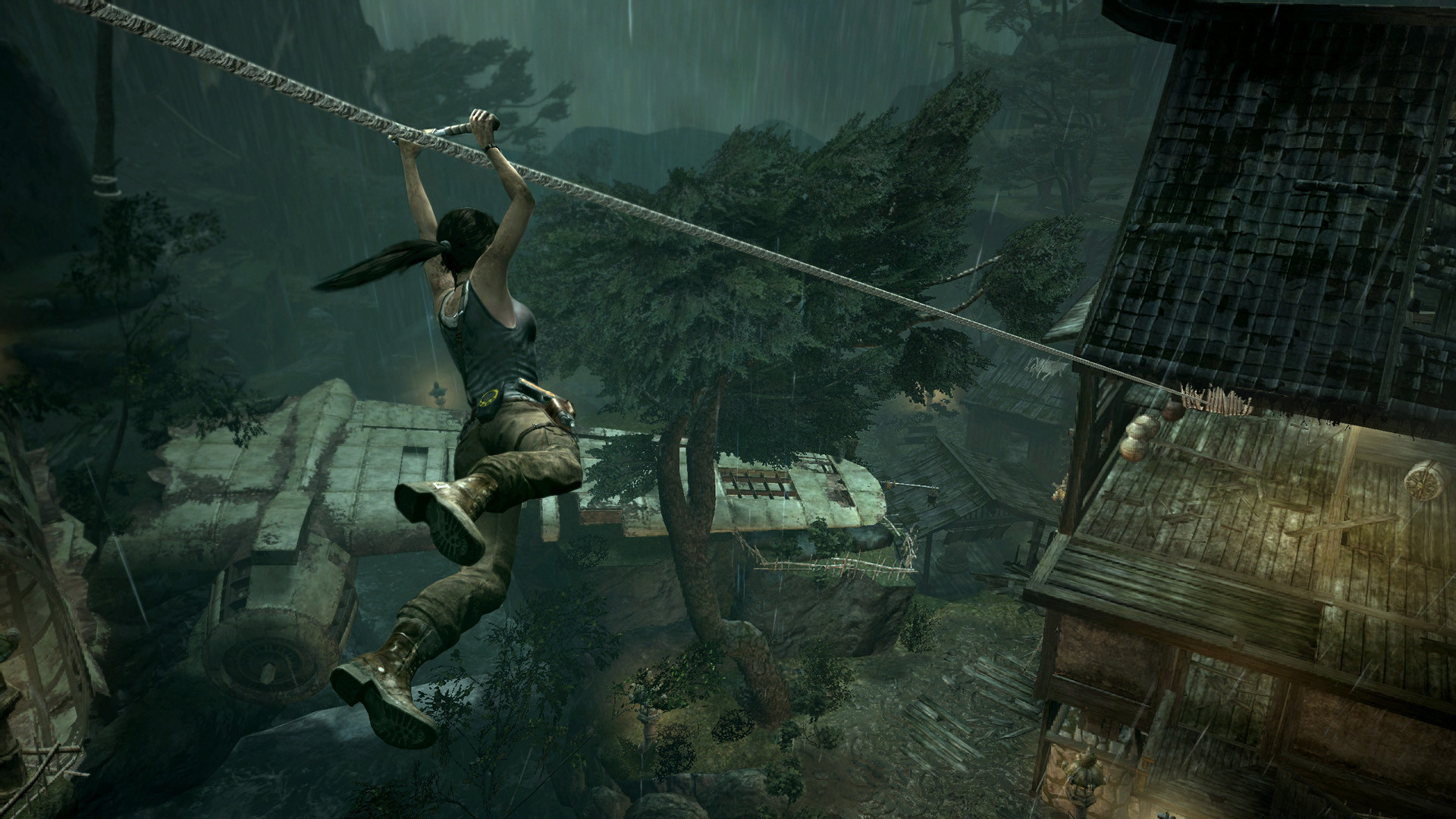
There were a few interesting mechanics, such as lighting things on fire, environment interactions, and scaling walls with your pickax. Using fire continuously to help you in various puzzles and in traversing the environment was very interesting to me, as fire is usually a damaging feature in games, as opposed to a helping one. The game uses a system of base camps to allow you to upgrade skills and weapons based on experience points and loot (called salvage in game). Lara can also change outfits and collect relics and journal entries, adding clues to the island’s mysteries.
The UI of the skills and gear was very awkward and non-intuitive to me. It took me forever to figure out where everything was, and I found it difficult to compare weapons in any way.
I also had to figure out that when I dug in a box and didn’t find something, it actually either just made an automatic change in my gear or added to my salvage, without me appearing to have grabbed anything.

Environment

Lara’s interaction with the environment is also a solid gameplay experience. She automatically takes cover when enemies are near, she reaches out to touch walls when she gets close to them, she lights a torch in dark tombs and looks around in interest at scenic areas. I loved the automatic cover, and would enjoy seeing it as an alternative to sticky cover in other games.
tomb-raider-2013-gameplay-screenshot
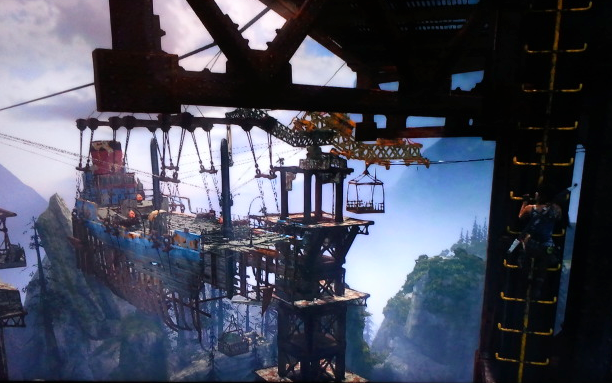
As I mentioned before, the game is vaguely reminiscent of the old Tomb Raiders, especially in the optional tomb maps. Each area is its own puzzle/platformer, and there are enough varied moments that no section ever becomes dull. You could be doing anything from steering a fall to jumping around sunken ships to scaling an ice cliff to running from flames. This was truly a game that kept me on my toes, and even the most ADD player would have trouble being bored.
However, one issue I had is that sometimes areas are so clearly traps that it feels ridiculous that you have to actually go to them. This is a combination of narrative and level design that leads to this issue though. It just made Lara seem dumb for going into those areas.
Although the level design is usually very fun, sometimes it was a “learn by dying” experience, as you slowly pieced together how best to proceed in the level. Some levels needed to be stealth, which wasn’t always apparent since most areas allowed you to choose your own approach. These areas were particularly punishing and frustrating.

Stealth

When it worked, stealth was mildly addictive. When it didn’t work, it was horrendously annoying. As most of you know, I don’t generally enjoy stealth games. I am very impatient, which resulted in my death numerous times because I didn’t wait for an enemy to move, or pay attention to where they were facing. Eventually, I learned to treat the game as if every mission required stealth until the mission proved otherwise.
Tomb-Raider-2013-Screen-4

Combat

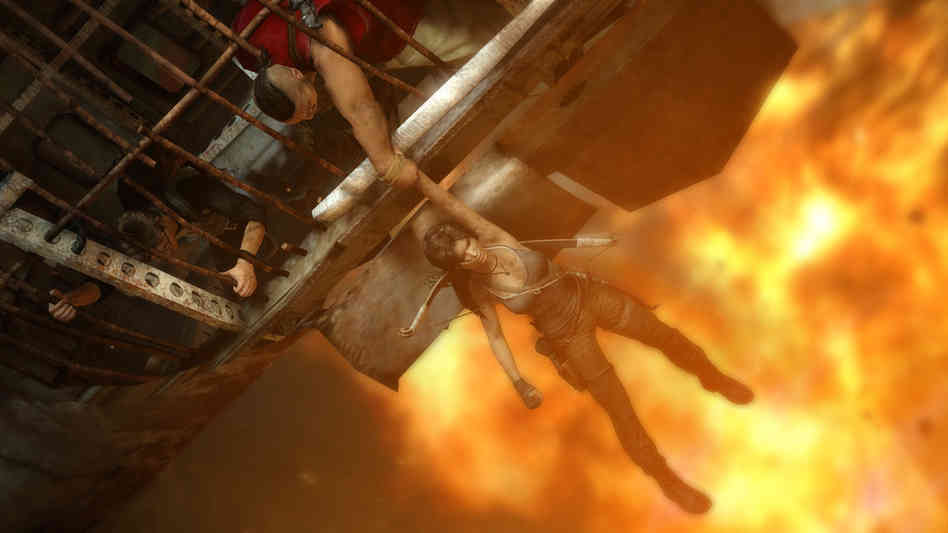
You will probably die in at least one fire-fight, as waves of enemies relentlessly pursue you, shooting up the frail boundaries you hide behind.
tomb-raider-2013
In general, combat is very well-paced with the story. Modding weapons leads to very satisfactory shooting experiences. One issue I had though is that Lara is so weak compared to the enemies. I can shoot some of them in the head twice and they don’t die… but if one of them has a rifle, I’m dead in seconds.
Enemies honestly cause more harm to themselves sometimes, setting things on fire, dropping napalm, cramming a choke point…lol, blowing up entire levels…lots of ways.
In general, combat became a more enjoyable experience the more I played and became used to the aiming mechanics, which felt slightly shaky in the beginning.

Multiplayer

Tomb Raider has four multiplayer modes:
  • Team Deathmatch – Team vs. team and highest score wins
  • Cry for help – Round based mode where survivors must activate radio transmitters while preventing batteries from falling into enemy hands
  • Survival of the Fittest – Kill other players without dying to become the executioner before time runs out
  • Rescue – Attempt to recover medical supplies while the Solarii must finish you with a melee execution
I played Team Deathmatch to get a feel for the muliplayer. It has a fairy simple set up: gain XP to get new weapons, mods, skills and characters. You get to choose which team you will play on, Survivors or Sollari. I liked that the system rewarded me not just for epic wins but also for epic fails, with a Feats and Setbacks feature.
The multiplayer is not bad, I just really wish they’d made it relate more to the main game. For example, all of the times the crew was separated from Lara could have been the setup for each of the multiplayer maps, with Lara calling in on walkie-talkie at the end of them.

Final Thoughts and Score

This game took me on a journey. I went from scared and naïve Lara to a badass warrior woman. There was a moment at the very end, where Lara does something iconic to the Tomb Raider franchise, and I actually cheered. This is the Tomb Raider we’ve been waiting for.
tomb-raider-2013-screenshot7
You know what else is amazing about this game? Women stood behind it. Girl gamers asked for it, bought it, played it, and mostly loved it. This is the proof the industry needs that “if you build it, they will come” should be their mantra! Gamers are hungry for more strong female leads in games.
Another favorite aspect of the game for me was something that even my male friends noticed: no one called me rude names! I was never “bitch” or anything like that. They called me the “Outsider.” Heck, some of the bad guys even talked about what an amazing shot I was! I love that positivity in things I kill.

Score: A-

Despite the sometimes punishing combat and Lara’s almost unbelievable naïvety in the beginning, this game proved to be a fun, fast ride worthy of any action flick, but with the solid gameplay of a classic.